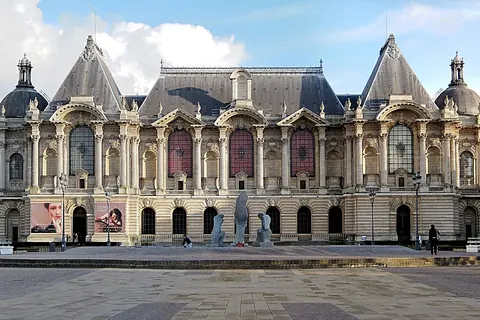
The Palais des Beaux-Arts de Lille is a municipal museum dedicated to fine arts, modern art, and antiquities located in Lille. It is one of the largest art museums in France.
It was established in the early 19th century through the initiative of Napoleon I. Jean-Antoine Chaptal’s decree of 1801 named fifteen French cities to house the artworks from churches and occupied European territories seized by the armies of Revolutionary France. Louis Joseph Watteau and his son François-Louis-Joseph Watteau, known as the "Watteau of Lille", played a leading role in the founding of the museum. In 1795, Louis Watteau drew up the first inventory of the paintings and François served as deputy curator from 1808 to 1823.
The museum opened in 1809 and was initially housed in a church confiscated from the Récollets before being transferred to the city’s town hall. In 1866, the "musée Wicar", formed from the collection of Jean-Baptiste Wicar, was merged into the Palais des Beaux-Arts. Construction of the Palais’s current Baroque-revival-style building began in 1885 under the direction of Géry Legrand, mayor of Lille, and it was completed in 1892. The architects chosen to design the new building were Edouard Bérard and Fernand Etienne-Charles Delmas from Paris. During the early 20th century, Victor Mollet served as its official architect. The building is located on the place de la République, in the center of the city, facing the préfecture of Lille. It was renovated during the 1990s and reopened in 1997.
At the start of the 1990s, the building’s poor state and the moving of Vauban’s relief models of fortified towns to Lille forced the town to renovate the building. Work began in 1991, under the architects Jean-Marc Ibos and Myrto Vitart, and was completed in 1997. This allowed the creation of a new 700 m2 basement room for temporary exhibitions, as well as departments for the relief models and for 19th-century sculpture. Overall the museum covers 22000 m2 and held 72430 pieces as of 2015, one of the largest provincial collections of fine art. The collection includes works by Raphael, Donatello, Van Dyck, Tissot, Jordaens, Goya, El Greco, David, Corot, Courbet, Toulouse-Lautrec, Delacroix, Rubens, Rodin, Claudel and Jean Siméon Chardin.
Sources
- Wikipédia (fr) : Palais des Beaux-Arts de Lille
- Wikipedia (en): Palais des Beaux-Arts de Lille
- Wikidata: Q2628596
- Official website
Text: introduction of the Wikipedia article Palais des Beaux-Arts de Lille, under the CC BY-SA 4.0 licence (authors: article history). Facts: Wikidata (CC0). Coordinates: Wikidata, map background © OpenStreetMap contributors.